
Putting Child Safety First in Early Childhood Education and Care
Child safety is at the heart of everything we do. Following the Rapid Child Safety Review (2025), Victoria is implementing major reforms to strengthen safeguards in early childhood education and care (ECEC). These reforms are designed to rebuild trust, protect children, and ensure services remain places of safety, learning, and care.

Supporting Child Safety in Early Learning Services
Why Child Safety Matters
Child safety is more than compliance, it’s about ensuring that every child feels safe, supported, and respected.
In 2025, the Victorian Government commissioned an independent Rapid Child Safety Review after deeply concerning allegations of abuse within early childhood education and care (ECEC) settings. Led by Jay Weatherill AO and Pam White PSM, the Review was delivered on 15 August 2025 and set out a clear path to rebuild trust and strengthen safety across the sector.
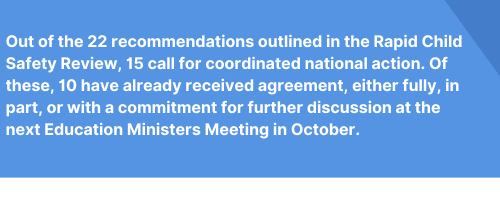
The Review made 22 recommendations designed to drive lasting change:
- Six aimed at strengthening the functions and powers of Victoria’s ECEC regulator.
- Three focused on improved training, education and professional development for educators, leaders and families.
- Two addressed reforms to key governance and regulatory systems, including the Working With Children Check (WWCC) and the Reportable Conduct Scheme (RCS).
- Eleven called for national collaboration and advocacy to ensure consistency across all states and territories.
Together, these recommendations provide a blueprint for a stronger, safer system, one that empowers educators, supports families and ensures that the wellbeing of every child remains the highest priority.
By accepting all 22 recommendations, the Victorian Government has committed to delivering the strongest safeguards yet for Victorian children and to building a sector that families can trust.
What’s Changing in Victoria?
Victoria is leading the nation with urgent reforms to place child safety at the centre of every decision in early childhood education and care (ECEC). These changes stem directly from the Rapid Child Safety Review, with all 22 recommendations accepted by the Victorian Government.

Independent Early Childhood Education and Care Regulator
A new, strengthened regulator will be established by the end of 2025, independent from the Department of Education. It will:
- More than double the number of compliance visits, with at least one unannounced visit per service every 12 months.
- Conduct modern risk assessments, supported by evidence-based tools and training.
- Be appropriately funded and staffed, including new Authorised Officers and specialist enforcement staff.
- Provide parents with clearer information by issuing modified quality ratings certificates and publishing compliance and enforcement actions more frequently.
Stronger Working With Children Checks (WWCC)
The Working With Children Check framework will be overhauled to close gaps in the current system and strengthen protections:
- Unsubstantiated allegations and intelligence will now be considered in clearance decisions.
- The WWCC scheme will gain powers to immediately suspend clearances while investigations are underway.
- Mandatory child safety training and testing will be required for all applicants before a clearance is granted.
- A new specialist review process will replace VCAT appeals, with reviewers trained to understand child-safety risks.
- Increased resourcing will allow the WWCC screening authority to conduct more detailed assessments and interventions.
Enhanced Reportable Conduct Scheme
The Reportable Conduct Scheme is being strengthened to ensure unsafe individuals cannot slip through regulatory cracks:
- Regulators will now have clear, proactive powers to share information, even if unsubstantiated, when it is relevant to a person’s suitability to work with children.
- The Scheme will be fully integrated with the WWCC under the Social Services Regulator, creating a single point of oversight.
- Administration of the Scheme will be resourced to meet growing demand, ensuring timely action when allegations arise.
Early Childhood Workforce Register
Launched in July 2025, the Victorian Early Childhood Workforce Register records all educators and staff across the sector. Its purpose is to:
- Provide a transparent record of who is working in ECEC services.
- Be fully compatible with a future National Worker Register, ensuring consistency across Australia.
- Support regulators to track movement of staff across workplaces and identify risks more quickly.
- Legislation to strengthen the Register will be introduced in October 2025, with full implementation within 12 months.
Support for Parents and Families
Parents will be given stronger tools and clearer advice to support child safety, including:
- Practical resources on prevention education, recognising signs of grooming, and how to raise concerns.
- Updated information on complaints and reporting processes, including access to the public hotline for enquiries.
- Easier access to service quality ratings and compliance information, so families can make informed choices.
- Ongoing consultation with parents and stakeholders to ensure the reforms reflect families’ needs.
Changes to National Regulations : Effective 1 September 2025
Significant updates to the Education and Care Services National Regulations came into effect on 1 September 2025, strengthening requirements around child safety, reporting, and the responsible use of digital technologies in early childhood education and care (ECEC) settings.
These changes are designed to ensure the safety, wellbeing and privacy of all children in care, while supporting services to meet new national standards.
Safe Use of Digital Technologies

Services are now required to have a policy and procedures for the safe use of digital technologies and online environments. These must be in place by 26 September 2025 and align with the National Model Code and Guidelines for taking images or videos of children in early learning settings.
A key change is the introduction of restrictions on personal electronic devices for anyone working directly with children.
This means:
- Only service-issued devices can be used to take or store images or videos of children.
- Personal devices such as phones, tablets or USB drives must not be carried or used during work with children, unless approved in writing for an essential purpose.
- Strict rules apply for how images and videos are stored and for how long they can be retained.
Restricted devices include: phones, tablets, digital cameras, smart watches, wearables with recording features, SD cards, USB drives and hard drives.
These measures reflect the Government’s priority to protect children’s privacy and safety by ensuring all images and recordings are securely managed and monitored within approved systems.
Since 1 September 2025, approved providers have been required under the Education and Care Services National Law to maintain clear policies and procedures for the safe use of digital technologies and online environments. These rules ensure that children’s privacy and wellbeing are protected whenever digital tools are used in early learning settings.
Most services have now reviewed and updated their policies to align with the National Model Code and Guidelines for taking and storing images or videos of children.
Approved providers were also required to confirm their service’s compliance with personal device restrictions by 26 September 2025 through the NQA ITS Portal. A step-by-step PDF guide remains available for reference here.
Regulators are now undertaking spot-check inspections and remote audits to verify that each service’s digital-safety policies and device-use procedures meet the new national standards. Where breaches are identified, services may receive compliance notices or directions, and in serious cases, face suspension or cancellation of approval.
These new obligations mark an important shift in how services manage technology: ensuring that every photo, video and online interaction occurs within a safe, transparent and accountable framework.
Faster Reporting of Allegations and Incidents
Approved providers must now notify their regulatory authority of any allegation or incident involving physical or sexual abuse within 24 hours of becoming aware of it. (Previously, services had up to seven days to report.) This change ensures quicker action and intervention when safety concerns arise.
NQF providers must:
- notify online via the National Quality Agenda IT System (NQA ITS).
CS Act services must:
- complete AS14: Notification of serious incidents, complaints and additional children attending in an emergency (PDF)
- email the PDF to licensed.childrens.services@education.vic.gov.au.
Smoke and Vape Free Environments
To protect children’s health and wellbeing, services must now be completely free of tobacco, alcohol, illicit drugs and e-cigarettes (vaping devices and substances).
Upcoming Changes to the National Quality Standard
From 1 January 2026, there will be further amendments to the National Quality Standard (NQS) specifically to Quality Areas 2 and 7, which relate to children’s health, safety, governance and leadership. These updates will reinforce the expectations of child-safe environments and strong service management practices.
Penalties for Non-Compliance
Approved providers who fail to meet these new safety and digital technology requirements risk significant penalties, including fines of up to $57,400 (for long day care, kindergarten and OSHC services) or $61,053 (for occasional and limited hours care), and possible suspension or cancellation of service approval.
Mandatory National Child Safety Training
From 27 February 2026, mandatory national child safety training has been introduced for everyone working in, or responsible for, early childhood education and care (ECEC).
This training is a key national reform aimed at strengthening child-safe practice and ensuring a consistent understanding of child safety obligations across the sector.
Who needs to complete the training?
The training is mandatory for all individuals involved in ECEC, including:
- Approved Providers
- Persons with management or control
- Nominated supervisors
- Persons in day-to-day charge
- Family Day Care educators
- all staff members
About the training

The training is being developed by the Queensland Government in partnership with the Australian Centre for Child Protection and is delivered through Geccko.
To access and complete the training, each individual must have their own Geccko account.
What services are doing
Services are:
- Asking staff, educators, volunteers and students to register for Geccko or log in and confirm their details
- Directing staff to the Geccko website for account support if needed
Service closures and PD subsidy
To support compliance, services may now close after 5:00 pm and continue to claim the Childcare Subsidy (CCS) for the time staff spend completing this training ; up to 5 hours per service per calendar year for centre-based services, or up to 5 hours per educator per calendar year for Family Day Care and In Home Care providers. This applies from 27 February 2026. Providers must keep simple closure records, and gap fees continue to apply in line with Family Assistance Law.
Download the Department of Education’s sector guidance: Service closure for national child safety training
To complement the service closures setting, the Australian Government’s Professional Development (PD) Subsidy will help CCS‑approved providers meet wage costs while staff complete the national child safety training, either by backfilling during work hours or paying staff to complete training outside usual hours. Applications are expected to open in Quarter 2 2026, with Grant Opportunity Guidelines (eligibility, rates and application requirements) published ahead of opening. Full details on the PD subsidy are available on the department of education’s website.
Why These Changes Matter
Every child deserves to feel safe and secure in their learning environment. By reducing risks linked to personal device use and ensuring faster responses to safety incidents, these regulatory changes strengthen the protection of children’s wellbeing and privacy in all early learning settings across Victoria.
Watch Webinars on Child Safety
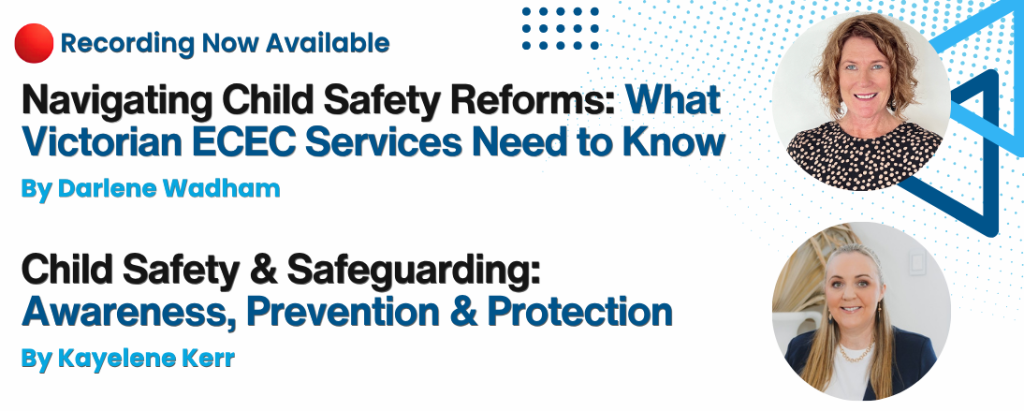
ACA Victoria has been actively hosting webinars to keep our members and the community informed. Fill in the form below to access recording to these sessions.
Frequently Asked Questions
Q: Can visiting professionals and students use devices (like phones, tablets or laptops) when attending an early childhood service?
A: Visiting professionals and students should contact the service before their visit to check the service’s policies and procedures about device use, as these may vary between services.
Services are expected to have clear processes for recording and approving device use by visitors, for example, confirming and logging that the device is issued by the visitor’s business, organisation or training institution.
If a visiting professional does not have access to a work-issued device and needs one to deliver their program (for example, to play music during an incursion), they may request temporary use of a service-issued device.
Any use of service devices by visitors should follow the service’s policies, including how photos or videos are handled, such as sending them to the visitor’s work or institution email and then deleting them from the service device.
Q: What are the expectations around photography and video recording during special events at early childhood services?
A: Approved providers must have clear policies and procedures for the safe use of digital technologies and online environments. This includes guidance on when and how images or videos can be taken by visitors, such as families attending special events.
Some services may ask families not to use personal devices to take photos or videos. Instead, the service might use a business-issued device to capture and share approved images or videos with families.
When engaging a professional photographer, services must ensure appropriate consents are in place and that procurement processes prioritise child safety. Policies should also outline how long images or videos are stored, and when and how they are securely deleted, with these details reflected in parental or carer consent forms.
Q: When can educators use digital devices during excursions, and what counts as an ‘essential purpose’?
A: During excursions, communication for an essential purpose refers to emergencies, for example, if a child becomes lost, someone is injured, groups become separated, or another serious incident occurs.
Any communication outside an emergency is considered routine and must be made using a service-issued device, not a personal one.
Approved providers should ensure enough service-issued devices are available whenever programs take place outside the service premises, including, during bush kinder, beach kinder, or other outdoor learning programs.
The number of service-issued mobile phones required for an excursion should be determined by the service through a risk assessment, considering possible hazards or situations where device use may be needed.
Q: What should services consider when using third-party platforms that store images or sensitive data?
A: When using third-party platforms, such as apps or online systems that store children’s information, images, or other sensitive data, services must ensure these platforms meet child safety requirements.
Under Child Safe Standard 9, services are required to have procurement policies that prioritise the safety of children and young people when engaging third-party providers. This includes checking how data is stored, managed, and protected.
Further information and guidance can be found on the Commission for Children and Young People’s website: ccyp.vic.gov.au/child-safe-standards/the-11-child-safe-standards/standard-9
Q: Can staff wear smart watches while working at an early childhood service?
A: Approved providers must have policies and procedures that restrict the use of personal electronic devices, including smart watches.
Smart watches that have inbuilt or remote camera or recording functions are considered restricted devices and should not be used in the service environment.
If a staff member wishes to wear a smart watch that does not have camera or recording capabilities, the service may request a written declaration confirming that the device does not include these functions.
Q: What happens if a service receives assurances from staff that later turn out to be false or non-compliant?
A: The Victorian Regulatory Authority takes a risk-based approach to compliance and enforcement, responding proportionately to the severity of any non-compliance.
If a breach occurs, compliance action is directed towards the approved provider, as they hold overall responsibility for meeting regulatory requirements. However, if an educator or staff member fails to comply with expected behaviours, the employer should take appropriate action under their own policies, procedures, and Code of Conduct.
Services are expected to conduct regular audits, risk assessments, and reviews to ensure their processes remain effective and compliant.
Q: What do services need to know about device branding and individual staff credentials?
A: All service-issued devices should have a clear identification code and be distinctly branded so they can be easily recognised, for example, by including a company logo on the lock screen, a custom case, or visible branding in the service’s colours.
Each staff member must also have individual login credentials and passwords for any online platforms or systems used by the service. Approved providers are responsible for setting policies and procedures to manage and monitor these individual accounts securely.
Q: What are the rules around taking photos of children during end-of-year events?
A: Services must ensure that any photography or video recording at events complies with the National Model Code – Statement of Expectations (NMC). All services are legally required to have policies and procedures for the safe use of digital technologies and online environments, and these must align with the NMC.
These policies should also address the use of personal digital devices by visitors—including families—during special events. Services must be clear with staff and parents about expectations to maintain a child-safe environment.
Additionally, services need to have the appropriate authorisations from parents or guardians to take, use, and store any images or videos of children being educated and cared for by the service.
Q. Can parents take photographs at end-of-year events?
This is a matter for approved providers and services to consider as part of their Safe Use of Digital Technologies and Online Environments policies. If providers do choose to allow parents and other attendees to take photos and videos, they must ensure that families are aware of the service policies and procedures and follow them.
Subject to the terms of your service’s policy, possible approaches that may be taken by services may include:
- engaging a professional photographer to take photos and videos at the event (with consent) from each family), and restricting attendees from taking photos, with clear communication in advance, or
- arranging for service staff to take photos with service issued devices, save them and share them with families after the event.
Q. What about parents taking photographs at an off-site venue?
Approved providers may permit families to take photos at events held offsite. If services choose to let families take photographs, providers must be clear about this in advance of the event and ensure that attendees are aware of the service policy and procedures for the taking and sharing of photos.
Q. How do we ensure parents adhere to our digital policies?
The Department of Education recommends communicating your organisation’s policies on event photography well in advance of any special events, with reminders in the lead up to the event. An announcement at the beginning of any event outlining the expectations around photography may also be helpful.
More information
- ACECQA’s policy and procedure guidelines on the Safe use of digital technologies and online environments and
- Child safe practices digital technologies and personal electronic devices webpage.
Child Safe Standards in Early Childhood Education and Care
Every early childhood service in Victoria must comply with the 11 Child Safe Standards, which set clear expectations for how organisations keep children safe from abuse and harm. The Standards provide a framework for creating inclusive, transparent, and accountable environments where children’s rights and wellbeing come first.
These Standards are regulated and monitored in early childhood services by the Quality Assessment and Regulation Division (QARD) as part of its integrated role under the Education and Care Services National Law and the Children’s Services Act 1996.
Below is an overview of the 11 Standards:
- Cultural Safety for Aboriginal Children: Create culturally safe environments that respect and support Aboriginal children’s identity.
- Child Safety and Wellbeing: Embed child safety in leadership, governance, and culture.
- Child Empowerment: Empower children to participate and have a voice in decisions that affect them.
- Family Engagement: Partner with families to build shared responsibility for child safety.
- Diversity and Equity: Recognise and respect the diverse needs of all children.
- Suitable Staff and Volunteers: Ensure all people working with children are suitable and supported.
- Complaints Processes: Provide accessible, child-focused processes for raising and managing concerns.
- Training and Support: Equip staff and volunteers with the knowledge and skills to keep children safe.
- Physical and Online Safety: Maintain safe environments, including digital spaces.
- Review and Improvement: Regularly assess and improve child safety practices.
- Implementation and Documentation: Clearly document and communicate child safety policies and procedures.
Together, these Standards form the foundation of a child-safe culture across the early learning sector.
Standard 8: Child Safety Training and Support
Strengthening knowledge and awareness is central to keeping children safe.
The Victorian Government has introduced training and professional learning measures to help educators, leaders and Approved Providers understand their child safety obligations and embed safe practices in their services.
Access free online modules, guidance and resources to build your team’s capability in identifying, preventing and responding to child safety concerns.
New Early Childhood Regulatory Authority in Victoria
From 1 January 2026, early childhood education and care in Victoria is overseen by a new independent regulator, the Victorian Early Childhood Regulatory Authority (VECRA).
VECRA has been established to strengthen oversight of child safety, quality and compliance across the early childhood sector. Its core purpose is clear: keeping children safe from harm and ensuring services meet the standards families expect and deserve.
The creation of VECRA follows the Victorian Government’s Rapid Child Safety Review, reflecting strong community expectations for more robust and transparent regulation of early learning services.
What this means for the sector
As an independent statutory authority, VECRA:
- Oversees safety, quality and compliance across early childhood education and care
- Continues regulatory functions with no disruption to existing operations
- Uses existing and new powers under National Law and Victorian legislation
- Takes swift and firm regulatory action where a child’s safety or wellbeing is at risk
- Works constructively with services to strengthen child-safe practices and improve quality
VECRA is led by Interim Regulator Adam Fennessy PSM and will continue to expand its capability throughout 2026, including increased on-the-ground oversight and more unannounced compliance visits.
Strengthening child safety oversight
As part of ongoing reforms, VECRA is focused on:
- Increasing the number of authorised officers
- Conducting more unannounced compliance visits
- Embedding new regulatory powers as legislation changes
- Improving how information is shared and analysed to identify risks earlier
- Publishing more compliance and enforcement actions publicly
Need Support or Have Concerns?
Child safety is everyone’s responsibility. If you have concerns about the safety of a child or need advice:
Concerns can be raised with VECRA by:
Submitting an online complaint (anonymous reports are accepted)
Contacting a local VECRA office
Calling 1300 307 415 (Monday to Friday, 9am–5pm)
to access an interpreter, refer to the National Translating and Interpreting Service (TIS National).
Early Childhood Wellbeing Support Program – free 24/7 counselling for ECEC staff, delivered by TELUS Health
Please know ACA Victoria is here for you. If you need support, guidance, or a listening ear, reach out to our team on (03) 9532 2017.
Our Shared Commitment
The child safety reforms mark a defining moment for our sector, one that strengthens trust, transparency and accountability. Together, as educators, leaders, families and government, we are building a culture where every child is safe, every voice is heard, and every service is supported to meet the highest standards of care.
ACA Victoria will continue to share updates and resources to help members implement these changes and maintain best practice in child safety. Members can access exclusive webinars, recordings and resources through the Member Portal.
Not yet a member? We’d love to support you, call us today at (03) 9532 2017 to find out how to join ACA Victoria.