Turning Oral Health Into Fun, Everyday Learning
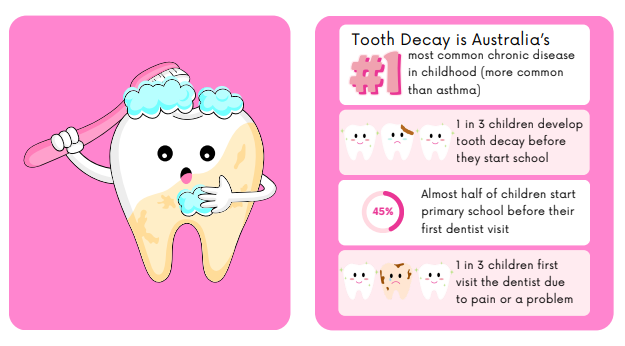
Tooth decay is Australia’s most common chronic childhood disease, more prevalent than asthma. Yet for many early childhood educators and kindergarten teachers, oral health education can feel like unfamiliar territory, something best left to dentists and parents.
Here’s the thing: you don’t need a dental degree to make a difference. And the impact you can have is bigger than you might think.
Baby teeth matter more than we realise
One of the most persistent myths in early childhood is that baby teeth don’t matter because they fall out anyway. In fact, the opposite is true; tooth decay as a child is the single biggest predictor of tooth decay as an adult. And with 1 in 3 children developing decay before they even start school, and almost half beginning primary school before their first dentist visit, the early years are a critical window.
Left untreated, tooth decay doesn’t just cause pain at the dentist. It affects a child’s ability to eat, sleep, speak, concentrate and play, and can quietly erode their confidence and self-esteem along the way.
It’s not just about sugar
Here’s something that surprises many educators: sugar doesn’t cause decay…at least not in the way most of us think.
Tooth decay is actually multifactorial, involving the combination of bacteria, sugar, time and the tooth itself. That means how children eat matters just as much as what they eat. Foods many of us consider healthy: dried fruit, crackers, flavoured yoghurt, fruit juice, can actually pose a greater risk than the occasional sweet treat, depending on how and when they’re consumed.
Understanding this changes the conversation, both with children and with families.
Oral health education doesn’t need its own timeslot
One of the most practical takeaways for educators is this: oral health education doesn’t need to be a separate topic on the program. It can be woven naturally into the rhythms of your day.
Celebrating a wobbly tooth. Asking children what flavour toothpaste they used that morning. A dentist corner in the dramatic play space. A simple science experiment. These small moments add up, and they’re already aligned with the Victorian Early Years Learning and Development Framework (VEYLDF) across multiple outcomes.
Play-based, inquiry-led, and genuinely joyful; oral health education done well looks a lot like great early childhood practice already does.
Talking with families: even the tricky conversations
Educators are often the first to notice signs that something might not be right with a child’s teeth. Navigating that conversation with families can feel awkward, but it doesn’t have to be.
There are simple, respectful ways to open those conversations: sharing observations rather than opinions, focusing on the child’s comfort and wellbeing, and positioning yourself as a partner rather than an authority. The right framing makes all the difference.
Want to go deeper?
This article has only scratched the surface of what was covered in our recent member webinar, Nurturing Healthy Habits: Oral Health in the Early Years, presented by the brilliant Dr Bethany Fisher; dentist, teacher, and creator of the award-winning Dr Bethany’s Tooth Tales program.
In the full session, Dr Bethany covered:
- The science behind tooth decay (including a science experiment that will delight your room)
- Practical, VEYLDF-aligned activities across story time, music, play and hands-on learning
- How to talk about food with children in ways that promote curiosity rather than fear or shame
- Scripts for navigating tricky parent conversations
- A suite of ready-to-use resources to take straight back to your service
Access the recording for free
Fill the form below to access the webinar recording and stay informed.